Some folks are born smooth. Others spend decades trying not to growl at the coffee pot before 9 a.m.
When you’re neurodivergent, some things that come easily to most neurotypical folks might always be harder for you. It doesn’t matter how long you’ve been working on them. Sometimes they get easier, but they never entirely go away.
This is what I tell my kids. It’s like dyslexia. We don’t tell dyslexic folks they can skip reading because it’s harder for them. The same goes for social skills or life skills that come naturally to others but that my kids and I struggle with. You still have to learn them. You just might need tools, strategies, and a whole lot of figurative duct tape.
For me, it’s things like checking my badge and phone several times on the way to work. Or remembering how to smile politely when someone asks a question that could’ve been answered by reading the thing I sent—twice. It’s a constant process of adaptation. Once, I did a practice drive the day before an interview so there wouldn’t be any surprises that might make me late. I still left an hour early the day of the interview, and I was still worried I would be late.
I’ve built systems. I’ve learned the tricks. I’ve done the work.
And one of my biggest adaptations? Keeping my inner curmudgeon under wraps and as well-masked as I can manage. That’s a lifelong project.
The first time someone told me I needed to work on my “collegiality” was more than twenty years ago. It was my twin brother, who happens to be naturally gifted at being the guy folks want to have a beer with.
But I’ve done the work. I’ve trained myself to attack problems, not people. I’ve come a really long way. I’m being strategic by not telling you just how far, because frankly there’s no reason to scare folks.
I’ve learned to give others the benefit of the doubt. I’ve learned to question my own gut reactions—don’t believe everything you think—and that strong emotions don’t always make for accurate conclusions. I’ve learned to pause before I snap, and when I do speak, to aim for calm instead of claws.
I’ve also learned to say, “Please stop whatever it is you are doing and leave the room,” in a mostly calm voice when my kids are fighting like cats and dogs in my room while I’m trying to work—instead of barking like a cornered raccoon.
Still, no matter how much progress I make, the reorgs keep coming. And with any new manager, it’s only a matter of time before I get what I call the “You Could Be Nicer, or at Least Less Frustrated by Other People’s Dumbassery” talk.
That’s when I pull out my Curmudgeon Bingo card.
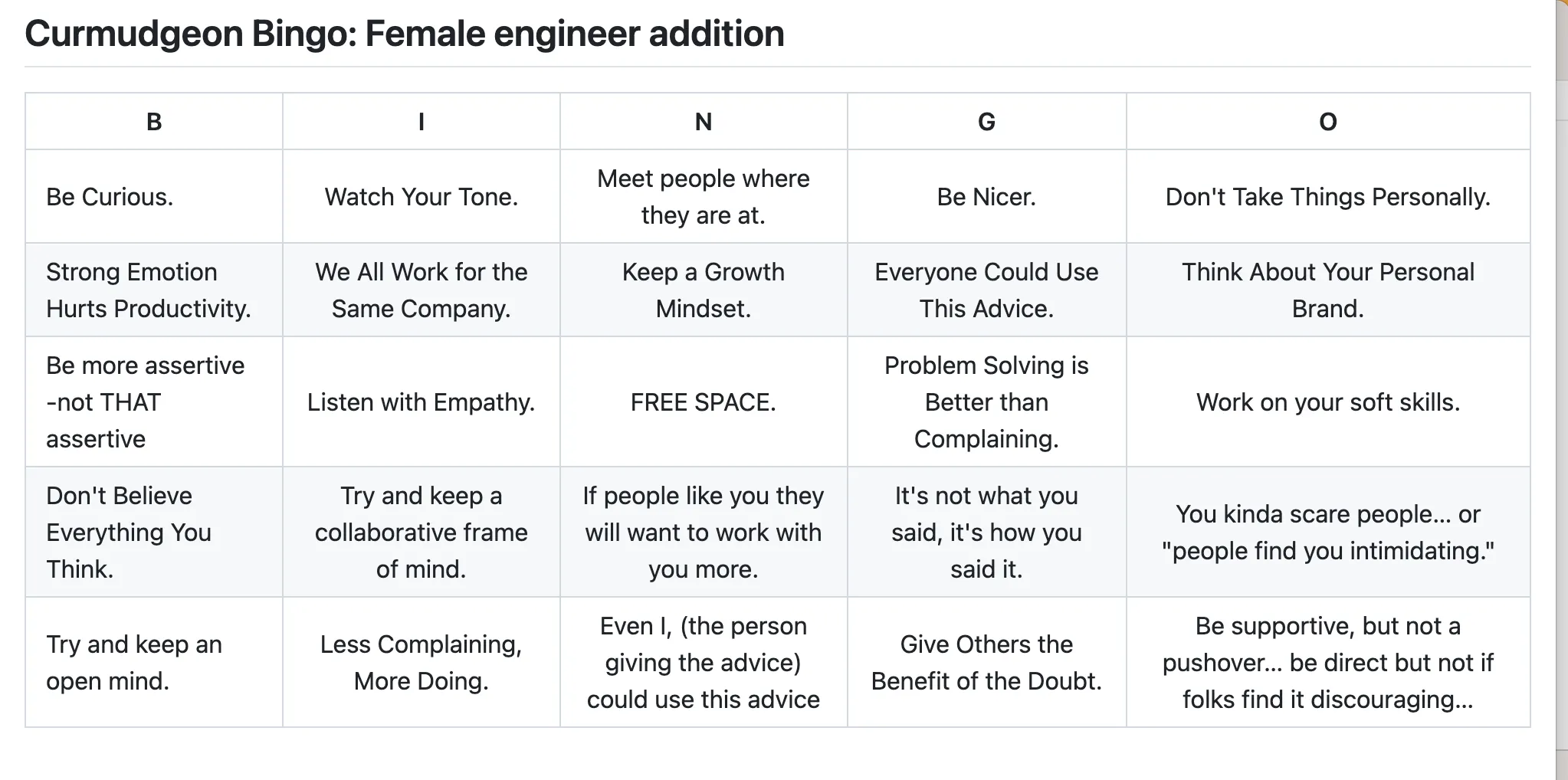
Let’s play
Keep a growth mindset. Oh, that’s a TED Talk classic, at least a decade old. I’ve used that one on my kids.
Everyone could use this advice—or its cousin, everyone could be better at this. This is typically used to excuse the thing folks don’t want to say or feel awkward saying. I literally got this in an annual review that included a promotion. They were trying to polish a turd written by a new manager who added in the “area for growth” section: “I promise you’ll feel a lot better if you solve problems rather than simply complaining.” Gasp! Revolutionary concept—problem-solving. In software engineering, no less. 😘
Strong emotion impacts your productivity. Oh my stars, No Ego by Cy Wakeman. One of my favorites. Say “What would great look like?” and I’ll do a happy dance. Haven’t heard it yet. Still waiting. I’m pretty sure it would work, though.
Don’t believe everything you think. Been in more than a few books. I think there may even be a book named after it. It’s solid advice, even when your whole nervous system says otherwise.
Listen with empathy. Classic Crucial Conversations line. Used correctly? Great. Used in a meeting where someone’s telling me how I’m “perceiving things too personally”? That’s a bingo.
Be curious. Also from a book—several, I’m sure. Heard an entire speech on it once. Good stuff. Great for kids, or for grownups trying to swallow unsolicited feedback.
Then there is the way, way old-school bonus round: Be nicer. Watch your tone. Be more likeable. Smile more.
I’ve mostly heard that last one from internet trolls, but it’s a classic. In fact, I’m going to fill in the rest of the bingo card with some of the things professional women get told regularly, since those often occur during the same talk.
Honorable mentions go to:
- Don’t take things personally.
- Some people find you intimidating.
- Think about your personal brand—because nothing says trust-building like a reminder that perception is more important than reality.
If you really want to push me to blackout bingo, quote something from Emotional Intelligence 2.0 or Crucial Conversations.
And if you quote anything from Never Split the Difference, you’ll be my hero. Seriously. Those aren’t even on the bingo card yet. It’s a good book. I try to read it once a year.
I know all these lines. I’ve read quite a few of the books. Hell, I could probably teach the course.
But I’m still neurodivergent. Still climbing the same damn, non-intuitive, definitely-doesn’t-come-natural “collegiality” mountain with no shoes and a backpack full of bricks. Every time someone shows up with their shiny advice, I smile, nod, and say, “Yes, of course. Everyone could be better at this. Who knew?”
Because that’s what adapting looks like.
And no matter how long you’ve been learning to climb that mountain, there will still be some new manager next month, next quarter, or next year ready to tell you the thing you’ve heard many, many times before: that proper shoes and fewer bricks would be useful in getting to the top.
Indeed.